We are hiring!
Bedern Bank

A sketch of houses on the west side of Bedern Bank, leading up to the cathedral from the Boroughbrige Road. The rooflines of some of these houses appear on the paintings of York Yard on the "Welcome" page looking up to the cathedral.
Bedern Bank was called Walkmiln Bank until the early years of the C14th, possibly because it led down to a mill on the banks of the river Skell. (In the C19th the mill was called Union Mill.) The name change of the road was the result of developments at the church (now the cathedral). The church in Ripon was a collegiate church, administered by a group (a college) of Canons. Each of Ripon's canons held a portion of church land with a house from which they received a stipend (an income). This set them apart from other canons and they were called prebends. It was common for each prebend to employ a vicar to carry out some of their work in the church. These vicars were employed on an annual basis and lodged in the town.
These arrangements were considered unstisfactory and in 1304 Nicholas de Bondgate gave land
on which to build accommodation for the vicars near the church and "enclosed against the resort of women". This accommodation was called a Bedern (a house of prayer. In old English "bede" = prayer, "aern" = house)
One hundred years after the building of the Bedern, vicars had drifted away to other accommodation. A new, larger Bedern was built and vicars were fined 12p (about £100 today) if they were absent.
The old properties on Bedern Bank had a sad history. Nothing is known of the properties on the east side of the road. They were probably demolished around 1700 when the Oxley family built a large Hall, now Minster House, home of the Dean. In the 1930s the city council had plans to build a relief road on Bedern Bank and they bought and demolished homes along the west side of the road as they became vacant. The road was not built but the scheme was revived in 1947 and in 1959 all remaining houses were demolished together with the houses in the three Yards off Skellgarths
Thorpe Prebend House
Grade II* listed
From the cathedral, down Bedern Bank, left at roundabout and left onto St Agnesgate. The house backs onto the road. A peak at the front over the fence at the side or on the footpath the other side of the river.
An unknown artist's impression of Thorpe Prebend House from across the river Skell. The house on the right was built on the bank of the river where the old river crossing joined the north bank. and St Agnesgate The ford was replaced by New Bridge in 1811.


A view of Thorpe Prebend House by the artist E W Haslehust (1866-1949) around 1900. The house appears to be verging on dereliction.
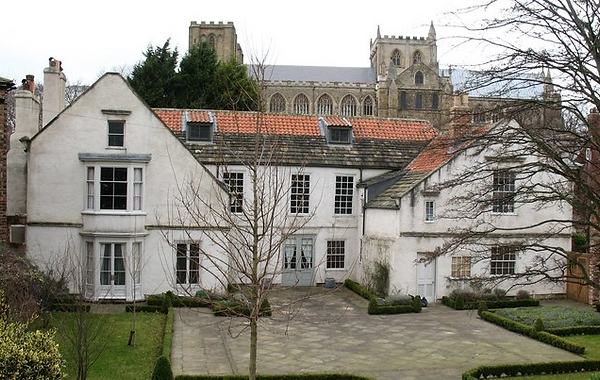
A recent photograph of the house after renovation. The oldest part of the house is thought to be the block on the right.
I

Thorpe Prebend house may have its origins in the C7th. The east wing is dated to 1517, the hall and west wing to 1584. The house was rebuilt in 1609 and internal alterations continued in the C18th.

In the C13th there were seven prebends of the church in Ripon. Six had a house within the parish of Ripon; (Bishop) Monkton, Givendale, Nunwick, Studley, (Little) Thorpe and Sharow. The seventh was Stanwick, north of Scotch Corner, where the prebend lived.
A plaque on the wall at the Minster Road end of Low St Agnesgate marks the site of Nunwick Prebend house where Charles I signed the Treaty of Ripon in 1640.
Treaty of Ripon.
The Scottish parliament rejected the Pope's authority and abolished the Mass in 1560. England had done the same in 1534 but the two countries adopted different versions of Protestantism. Charles I in the 1630s attempted to impose his version on the Scots who refused to accept it. Two wars followed called the "wars of the bishops". The treaty of Ripon in 1640 brought a truce in the second war and was favourable to the Scottish side. While it ended hostilities, it allowed the Scots to maintain their occupation of Northumberland and Durham until their grievances were addressed and their expenses paid. The treaty also agreed to the payment, by the English, of Scottish forces of £850 each day until a final settlement of the war (£181.500 today)