We are hiring!
The Obelisk, the Market Square and the Hornblower
The obelisk is one of three grade I listed buildings in Ripon and is in the centre of the market square.

A view of the obelisk looking across the market square to the south west corner. The obelisk replaced an earlier market cross in 1702, but the artist has retained the old name. The building with the cupola is now (2025) occupied by the Yorkshire Building Society, but the cupola has gone. The Wakeman's house is far left but the house next door has been demolished and the site that is now HSBC bank is occupied by cottages.
From a painting by the York artist Jessie Dudley (1872-1930)

The market square on market day (Thursday) looking towards the south west corner of the square, the juction of Westgate and High Skellgate. The town hall is far left.
The artist is Parson(s) Norman (1840-1914). Born in Newington, Surrey, he spent his early life in East London, but moved to Suffolk in 1878 and joined the Ipswich Fine Arts Club. He exhibited at the Royal Academy.
The obelisk was constructed in 1702 as the centre-piece of a newly paved market square. It is 82 feet high and cost £564.11s. 9d. (about £115,000 today) It was the first free standing obelisk in the country and was designed by Nicholas Hawksmoor who later designed the obelisk at Castle Howard. Daniel Defoe, in his "Tour through the whole Island of Great Britain", 1724-6, described the completed project as "the finest and most beautiful square that is to be seen of its kind in England."
The aim of the project was to improve Ripon. John Aislabie, Mayor of Ripon and owner of the Studley Royal estate, funded the project and the stone for the obelisk came from his estate. From 1695 he was Ripon's M.P. and became Chancellor of the Exchequer. He was also responsible for designing the landscaped gardens and grounds of Studley Royal which, together with the ruin of Fountains Abbey, is a World Heritage Site.

The market square looking south west. Gas lighting has arrived in Ripon and the buildings appear much as they are today. Not only has the cupola disappeared from the top of the building on the corner (second right) the whole of the top floor has gone.
The metal finial at the top of the obelisk. It incorporates the hornblower's horn and the Ripon spur rowel (the star wheel on the back of a spur which some of us remember from the days of "cowboys and indians" films), Both are symbols of the City. They stand above a Fleur de Lys.


The plaque on the obelisk is an exercise in how not to do it. The inscription says:
MDCCLXXXI (1781)
Erected at the expense of
William Aislabie Esquire
who represented this borough
in parliament sixty years.
The Mayor, Aldermen and Assistants
of Ripon ordered this inscription
MDCCLXXXV (1785)
The Honourable Frederick Robinson
Mayor
The obelisk was, in fact, erected in 1702 by William's father John Aislabie, at his own expense. He was also an MP for Ripon. William was responsible for the renovation of the obelisk and surrounding structures in the 1780s.

The City coat of arms showing the Ripon rowel on the spur, the horn and the motto which is also inscribed along the top of the town hall.

Artist's image of the hornblower standing beside the obelisk in front of the town hall. Artist unknown.
The tradition of the Ripon hornblower goes back to King Alfred the Great who, in the year 884, granted the town of Ripon a Royal Charter and donated a horn which became known as the Charter Horn. Ripon people were living through a period of Viking raids and, at Alfred's suggestion, appointed a Wakeman to keep watch over the town from dusk till dawn. He announced the start of his watch by blowing the horn at each corner of the obelisk. But over the years the wakeman accumulated powers to tax the population and to employ local people to "police" the town.
King James I, in 1604, issued a new Charter which removed the post of wakeman and replaced it with an elected Mayor. The last wakeman, in fact, became the first mayor. The Mayor appoints a hornblower to continue to announce the start of the watch. The ceremony still continues, but at 9.00pm each day. It was not disrupted by either world war or the covid pandemic (but the horn was blown at the home of the hornblower during covid, and not the market square, and shown on Facebook!). There is now a small team of hornblowers, which can include all genders, rather than a single man.

The year 886 (trigger warning; this may not be true!)

The year 1690. Cost 6s.8d or 34p equivalent to £71 today.

Three of the five Ripon horns. An additional horn was donated in 1986 to mark the 1100 years since the first charter. Another horn was bought by the City in 2018 so that each of the team of hornblowers had access to a useable horn.
The year 1886
The Unicorn Hotel
A grade II listed building
The Unicorn Hotel is in the south east corner of the market square. It is possible that the original hotel was the four storey building on the right. Half of the three storey building on the left is a shop (now The Works, but a printer's for many years). The other half is part of the hotel, and signs between the second and third floor windows of both buildings say "Unicorn Hotel". The hotel was a coaching inn although there is no direct access from the square to the rear of the hotel for the coaches. Access is through an archway on Kirkgate.

The building in the picture (by an unknown artist) is 18th century but parts of the site are older. Their are records of an inn from the 14th century and may have been called the Unicorn in the early 17th century. The buildings to the left of the hotel appear to have been bought in the 1760s to expand the Unicorn.
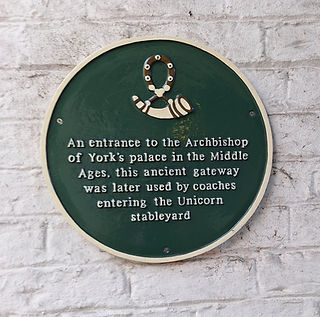

The entrace to the stables of the Unicorn was from Kirkgate. It is still there and now gives access to the bus station and main car park.
Statue of Saint Wilfrid.

Unnoticed by most people, the statue is fixed to the wall of 39 market square (south), the building to the left of the town hall. It is a stone sculpture set in a metal niche. The sculpture is all that remains of two previous buildings on the site demolished in the early 1960s.
St Wilfrid is the Patron Saint of Ripon. He had become Abbot of a newly founded monastery established in the town in 672AD by a group of monks from Melrose Abbey. The church in Ripon (now the cathedral) is dedicated to St Wilfrid and St Peter.
There is an annual procession for St Wilfrid every year in late July or early August.

The building on the far left of the photograph was the Claro Bank, and in the centre of the triangular parapet at the top of the building was a niche in which the statue of St Wilfrid was placed.
In the 1960s the Claro Bank building and the building to the right of it (possibly also part of the Bank) were demolished and replaced with a new building for the National Westminster Bank. This was possibly the ugliest building in Ripon but it displayed Wilfid's statue. In recent years the building has been remodelled and now borders on the attractive.
The photograph is of a celebration around the town hall (the white building). It is possibly Queen Victoria's diamond jubilee celebration (1897) when the Marquess of Ripon gave the building to the people of Ripon.
Saint Wilfrid
633 Wilfrid was born into a noble family in Northumbria (all the lands north of the Humber river, which included present dayYorkshire.) He entered religious life in his teens and studied at Lindisfarne, Canterbury, France and Rome.
660 returned to Northumbria.
Christianity was still new in Britain. It had come via two routes; Celtic (Irish) Christianity over the Irish sea and Roman Christianity over the channel. From his training in Rome, Wilfrid was of the Roman persuasion.
It is no surprise that the two groups could not agree on many things. They argued particularly about the date set for Easter. The issue was further complicated in the North because the king of Northumbria (Oswiu) was of the Celtic persuasion but his wife and son (Alhfrith) were of the Roman persuasion.
660 Wilfrid was given oversight of the monastery of Ripon by Alhfrith king of Diera (Yorkshire) under his father, king of Northumbria. The monks from Melrose Abbey, who had established the monastery, were of the Irish persuasion so Wilfrid sacked the Abbot and filled the post himself. Monks who were not prepared to accept the Roman rites were expelled, including Cuthbert, later a Saint. Wilfrid was soon consecrated a priest and later a Bishop of York and bishop of Northumbria. He chose to be consecrated in Gaul but on his return
At the Synod of Whitby, in a group set up to agree the method for determining the date of Easter. Wilfrid led those , speaking for the Roman method which, won the day and was agreed by the Synod.
The Crown Hotel

Sainsbury's supermarket now stands on the site in the market square once occupied by a coaching inn called the Crown Hotel, closed in 1907. On the outside wall of the Hotel was fixed the rather fine carving of the crown (picture left). When the hotel was demolished the crown was kept in Ripon museum but, when the museum closed, it was refixed to the wall of the new building in 2003. Unfortunately, it didn't weather well and fell off the wall in 2014 and was seriously damaged. It was restored with the help of the Civic Society and Sainsbury's and placed inside the supermarket. It can now be seen at the back of the supermarket on the wall above the trolley ramp.


The Crown Hotel, just north of the Unicorn Hotel, before development. The crown can be seen at he top of the building above the carriage entrance.