We are hiring!
Ripon's drinking fountains
From the south-west corner of the market square, down High Skellgate, across the traffic lights onto Low Skellgate, cross Borrage Bridge onto Harrogate Road, 250 metres to the terrace of Georgian houses (Borrage Terrace) on the right. The fountain on the roadside is in front of the last house in the terrace.


The pipework has been removed and the basin filled with cement.
When the fountain was built in 1758 it was the first structure on Harrogate road. Ripon township stopped at the skell and the road from Borrage Bridge led to open countryside. Harrogate road would have been a track along which pedestrians from the south could enter Ripon on horseback, cart or on foot, although the main route into Ripon was probably along what is now Quarry Moor Road, through the township of Bondgate with Aismunderby. The fountain was built over a well and on the early maps it is marked "well". In its early life the southern most house on the terrace was called "Well House".
The Fountain on Skellbank
from the southwest corner of the market square follow Westgate onto Park Street. Ripon Spa Gardens are on the left. Cross diagonally across the gardens onto Skellbank. The fountain is on your right as you leave the gate from the gardens.


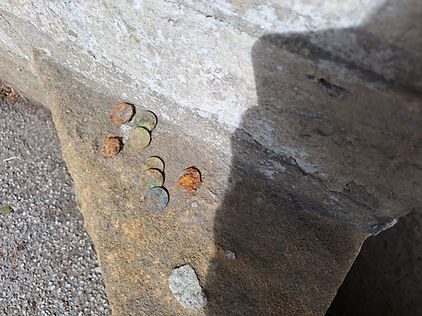
Coins found in the fountain when it was emptied.
The fountain on Skellbank is just below Ripon Spa Gardens and built over St Wilfrid's well. At the time of the photographs it was empty of water for cleaning. Normally the water still runs into the trough and exits through the overflow grill. There appears to be no inscription on this fountain but in his will, Dr Richardson gave £2 a year for the upkeep of the two wells.
While the fountain on Harrogate road had a passing clientele, it is less easy to see why the fountain was built of Skellbank which, in pre-Victorian times, went nowhere. However, animals may have been herded along tracks leading on to Skellbank then up to the market square. But, builders of fountains would have needed a source of water which would have limited where they could be built to the points where spring water emerged from the ground.
The mill race ran along the opposite side of Skellbank, an open stream providing power for the mills it ran past on the edge of the town. Water entered the mill race at a dam at High Clough on the river Laver. It was returned to the river Skell beside New Bridge which carries the road to Boroughbridge. Why was this not an adequate source of water for passing animals?
William Richardson M.D. was a local doctor in Ripon. He was born in Brierley near Bradford in 1709 to Richard Richardson, also a doctor. He attended Bradford School and obtained entry to Jesus College, Cambridge in 1728, moving to St John's College the following year where he matriculated age 18. In 1736 he was awarded the degree of M.B. (Bachelor of medicine) and in 1741 M.D. (Doctor of Medicine). He practiced in Ripon where he funded the two drinking fountains.
William died, unmarried, in 1783 and is buried in Cleckheaton.
On the reverse of his will Dr Richardson had written that, after his death, he recommended the wells to the care and protection of "the corporation". He also left a charity which included £2 a year to a person for taking care of the wells in and about the town of Ripon. Other money was left for the support of the poor of Ripon.

In this sketch the drinking fountain over St Wilfrid's well can be seen on the left with the public BATHS on the side of Skellbank in, what is now, Spa Gardens.
