We are hiring!
What was a medieval hospital?
Medieval hospitals numbered about 1000 across the country, mostly built by the Normans after the conquest in 1066. Those in large towns were usually established as part of a priory or abbey, the founder funding the cost of both. The priory was able to support the hospital with funds and staff. These hospitals were often large and successful. The largest hospital in England was St Leonard's in York with over 200 beds. Two people to a bed was not uncommon so that number could double.
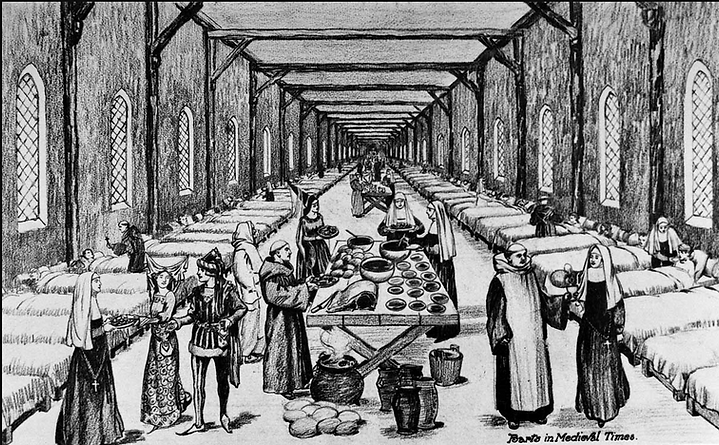
A Victorian view of St Barts medieval hospital in London. It is very much a dormitory with no hint of privacy

Two to a bed was common, irrespective of symptoms, but no mixing of sexes.
Hospitals in smaller towns like Ripon usually accommodated aound 6 to 12 men or women. These hospitals relied for their income on the size and nature of the endowment from the founder and ongoing gifts of money, land or property from benefactors. Many of these smaller hospitals did not survive because their income was insufficient or because the income available was corruptly used by the man in charge (the master, warden or custos). The less he spent on the hospital the more he kept in his pocket. So many small hospitals regularly verged on dereliction, residents were not fed nor were alms given to the poor.
In medieval times people did not go to hospital to be cured when they were ill. The causes of illness were unknown. Nobody knew about bacteria, viruses, fungi, microorganisms, so there were no cures other than medicinal herbs which were known to relieve some symptoms. Neither were there doctors and nurses as we know them today. Medieval hospitals offered hospitality to the destitute; those with no home, no family, no food, no clothing ..... Hospitals also offered overnight accommodation to travellers. Some hospitals made provision for specific groups of the needy. St Mary Magdalen in Ripon was a leper hospital and had a building to accommodate those with leprosy outside the northern boundary of the hospital, towards the river Ure. When the Normans conquered England in 1066 they discovered the country had a major leprosy problem. Of the roughly 1,000 hospitals they built, about 250 offered accommodation to lepers, not to cure them or to lock them up, but to provide them with a place to live when local communities had rejected them.

As medieval hospitals evolved, partitions were erected to provide some privacy. Initially these were possibly curtains (as in modern hospitals) but later became wooden partitions. In this Victorian sketch the beds look very upmarket. In many hospitals a straw palliasse was more likely.
Other specific groups that were offered accommodation by some hospitals included unmarried mothers, who were often rejected by there communities for committing a major sin. But, if the mother died during childbirth the hospital was committed to care for the child until her/his seventh birthday, the age at which the child was expected to work. Other groups catered for included blind priests, aged clergy, cripples, the insane, converted jews, all groups rejected by their communities. Accommodation for converted jews was interesting, Jewish people were persecuted in England as they were elsewhere. Some were desperate enough to convert to Christianity. Converts could be supported in hospitals, jews could not. In 1290 all jews were expelled from England but converts could stay. The ban remained for 400 years until Cromwell lifted it in the 1690s.
In medieval times, where did prople think illness and destitution came from? They came from God. God could give and God could take away. Illness and destitution were God's answer to those who had sinned, and the cure was prayer. Sleeping provision in smaller hospitals was arranged so that each resident could see the altar and the priest conducting daily Mass. Priests were the doctors of their day. For part of its life the hospital of St Mary Magdalen in Ripon had five priests to minister to a tiny number of residents. For many residents regular meals, a roof over their heads, somewhere to sleep, provision of clean clothes together with general care, as well as regular prayer, saw major improvements in their health. They could then be helped back into their local communities.. Today, doctors and nurses cure us with the intervention of medicines or surgery. In medieval times it was priests, with the intervention of prayer, although barber surgeons would have a go at surgery on anyone brave enough, or desperate enough to allow them!

Later, the partitions became permanent, a door was added together with a roof over the top, forming individual cells. In some hospitals the walls and roof were built of stone, within the hospital building. By Tudor times, these cells had evolved into almshouses, constructed outside the original hospital building (which often survived as a chapel) but remaining as single rooms with a common roof.
Hospitals were legal entities.
Some hospitals, like St Mary Magdalen and St John the Baptist in Ripon, were well endowed by their founders with gifts of land and buildings. Many hospitals received endowments of land and buildings or gifts of money left by local people in their wills or as an occasional habit. Where hospitals engaged in the buying and selling of their property, they required a seal to formalise the deal. Few medieval hospital seals survive and although there is reference in documents to the seals of St Mary Magdalen and St John the baptist, those references could only offer an impression of the seal of St Mary Magdalen, the seals having been lost.
In 2024 the seals were discovered hiding in a solicitor's office in Ripon.


The metal Seal of the hospital of St John the Baptist with the image of St John sitting on the throne with a lamb in his lap holding two pennant flags over the right shoulder of St John.
The inscription around the side of the seal reads;
SIGILLUM HOSPIT.S.JOHAN
BAPTISTAE JUXTA RIPON 1643 +
Seal of St John
Baptist next to Ripon 1643
(Sigillum is a figure cut on a signet ring = seal)
Notice that the seal states that the hospital is next to Ripon, not in Ripon. It was just south of the river Skell in the township of Bondgate.
The wooden seal of the hospital of St Mary Magdalen showing a standing St Mary holding a jar of ointment in her right hand and a book in her left hand. The inscription reads;
MAGDELENE RIPOVN
HOSPITALIS BTA MARIE
Magdelene Ripovn
Hospital Bta Marie
Bta = Beata (blessed)
Why a V in Ripovn?
Apparently seals were replaced from time time through wear or loss so the two seals will not be the originals. The date on the seal of St John the Baptist may reveal its age.